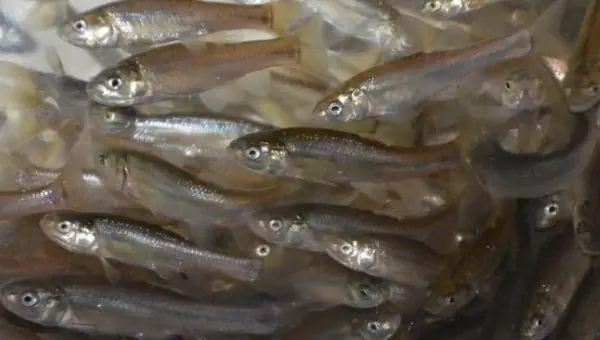
Why is the fathead the forage minnow?
The farm puts it plainly in its own species guide: as forage species go, there is no substitute for the Fathead Minnow. It is also an excellent live bait, so the same fish does both jobs, feeding a pond's bass and sunfish or hanging on a hook.
Fatheads are graded by width into three sizes, and as with every fish at the farm the counts are approximate. A small fathead is about 1 1/2 inches and 250 to the pound, so a 4 lb box holds roughly 1,000. A medium is about 2 1/4 inches and 167 to the pound, roughly 668 to a 4 lb box. A large is about 2 1/2 inches and 83 to the pound, roughly 415 to a box.
On the store, fathead minnows run from $85 to $155 depending on size and box weight. They ship from Anderson Minnow Farm at 4377 Hwy. 70 West in Lonoke, Arkansas, on Mondays and Thursdays, and orders must be in by 10:00 a.m. Central on the shipping day.
What are pink fatheads and feeders?
The pink fathead is the same species with a rose color that shows up well in the water and in a bait bucket. The farm lists pink fatheads at about 167 to the pound, running from 1 inch to 2 1/4 inches, so a box holds roughly 668. Pink Minnow starts at $90 on the store.
Feeders are the smallest grade, about 3/4 to 1 inch and around 1,500 to the pound. That is a very large count in a small box, which suits anyone feeding larger fish in a tank or pond, or stocking a body of water with the tiniest forage.
If you are unsure which size to order, the 1-800-20-MINNO line, 1-800-206-4666, is staffed Monday through Friday, 7:00 a.m. to 4:00 p.m. Central, and the people there handle the shipping questions every day.
Stocking a pond is not the same as filling a bait tank
For a pond, forage minnows are fish you are releasing, so think about what is already in the water. A fish that fits easily in the mouth of your largest predators will be eaten fast, and a size that is too big will go uneaten. That is the reason the small and medium grades are the usual forage picks, while the large suits bigger predators.
For a bait tank, the work is keeping them alive. The farm's guidelines call for a well-aerated tank of fresh water, with a remover added if you are filling from a municipal supply to take out chlorine and chloramine. Keep the tank in shade all day or in an air-conditioned building, and match the tank volume to the water temperature, since warm water carries fewer fish.
Every order is covered by the farm's guarantee that fish arrive alive and healthy. If something is wrong, contact the farm within 24 hours with photos, by text, phone or email, and the fix is a refund or account credit. Follow the instructions in the box, because the guarantee depends on it.